AI Amazon Repricer
Boost your Amazon profits and avoid price wars with AI repricing
 Skip to content


A look at the categories that spiked, the ones that quietly collapsed, and what the gap between them says about how we actually behave when everything is on sale.

Share this post


A look at the categories that spiked, the ones that quietly collapsed, and what the gap between them says about how we actually behave when everything is on sale.
Every year, Prime Day gets reported the same way: record sales, big discounts, a few headline gadgets. The number goes up, everyone nostalgically remembers when it was just one day, and the coverage moves on.
But the interesting story was never in the total. It’s in the split: which categories surged, which ones fell, and what the distance between them reveals about the people doing the buying.
We track Amazon order activity in real time, and when we broke Prime Day 2026 down to the category level, a pattern emerged that was far more human than commercial. Across dozens of unrelated product categories, the same instinct kept showing up: when everything is on sale, people buy the exciting version of a thing and skip the boring, necessary version of the same thing.
Once you see it, you can’t unsee it. Here’s what the numbers actually said.
If you had to guess the single biggest category jump of Prime Day, you’d probably reach for something obvious: a flagship electronic, a viral kitchen gadget, a TV.
You’d be wrong. The runaway winner was skin care tools, up a staggering 1,034% in sales, with units sold rising more than five-fold. Not skin care products. The tools.
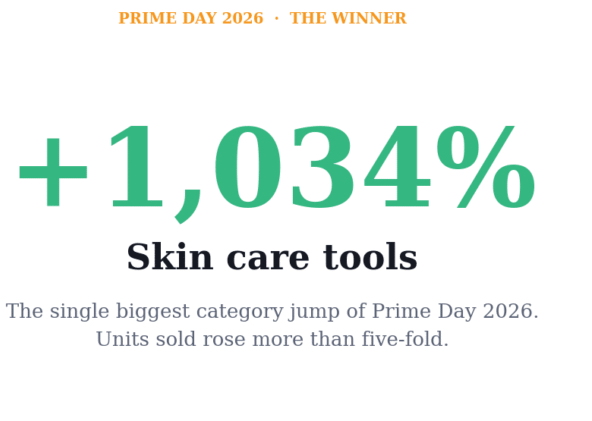
From roughly $15k to $168k in a single event. Skin care tools were the runaway winner of Prime Day 2026 — and units, not just prices, drove the jump.
Gua sha stones, LED face masks, microcurrent devices, the whole category of gadgets that promise to do at home what used to require an appointment.
This is the beauty-tech boom made visible. For two years, “skinfluencer” culture has been pushing these devices hard, but they carry a psychological hurdle: they’re expensive enough that people hesitate at full price. Prime Day removed the hesitation. The moment the discount landed, months of “maybe I’ll get one eventually” converted into a purchase all at once. The fact that units rose even faster than revenue tells you this wasn’t a few big spenders. It was a genuine crowd finally pulling the trigger together.
Here’s where it gets interesting. There’s a well-documented cultural narrative that young people are rediscovering “analog” technology: vinyl records, film cameras, the tactile pleasures of the pre-digital world.
It’s a nice story. Prime Day put it to the test, and the results were split.
Vinyl passed. Turntables and stereo components climbed over 100%, speakers up 166%. The analog audio revival is backed by real money.
Film photography failed. While digital cameras leapt 160% and camera lenses rose 143%, film photography fell 26%. The romantic idea of shooting film is real right up until the moment a genuinely good deal on a digital camera appears. Then people quietly choose convenience.
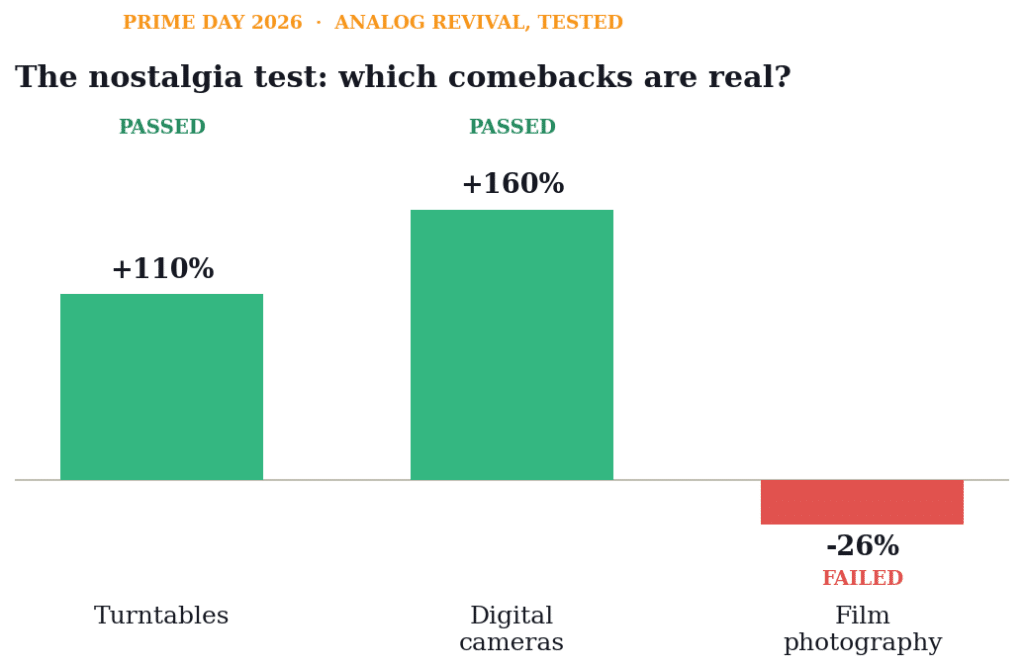
The analog revival, put to the test by a discount. Vinyl and digital cameras converted; film photography didn’t.
The lesson isn’t that nostalgia is fake. It’s that nostalgia has a price ceiling, and it’s lower than we like to admit. When a discount forces a real decision, people reveal which retro trends they actually value and which ones were mostly aesthetic.
Now the pattern starts to sharpen. While shoppers poured money into gadgets and beauty devices, one category fell strangely silent: fresh food.
Ice cream dropped 34%. Seafood fell 46%. Bacon collapsed 53%. These aren’t rounding errors. They’re steep, consistent declines in exactly the everyday items people normally restock without thinking.
What happened? Prime Day rearranges the mental budget. For a few days, spending attention shifts entirely toward the durable, the discountable, the exciting: the things you only buy when they’re on sale. Perishable food is none of those things. You can’t stockpile ice cream to take advantage of a deal, and dinner doesn’t feel like a treat when there’s a 40%-off smartwatch in the cart. So the fresh-food run simply gets postponed. People will restock the fridge next week. Right now, there are better things to buy.
If there’s one finding that captures the whole psychology of Prime Day, it’s this pair.
Grills and smokers rose 149%, a huge jump. But the tools and accessories to actually cook on them fell 25%. People bought the big, shiny centrepiece and skipped the tongs, the covers, the thermometers, the unglamorous kit that makes it usable.
Now look at pools, and watch the mirror flip. Swimming pools fell 48%. Nobody was buying the big-ticket item. But pool parts and accessories rose 50%. People spent on maintaining the pool they already owned, and declined to buy a new one.
Put them side by side and you see two different halves of the same instinct. With grills, the object is exciting and new, so people buy the object and ignore the upkeep. With pools, the object is a known, expensive commitment, so people invest in the upkeep and avoid the object. In both cases, the aspirational purchase wins and the practical purchase loses. It’s just that “aspirational” means opposite things depending on whether you already own the big thing.
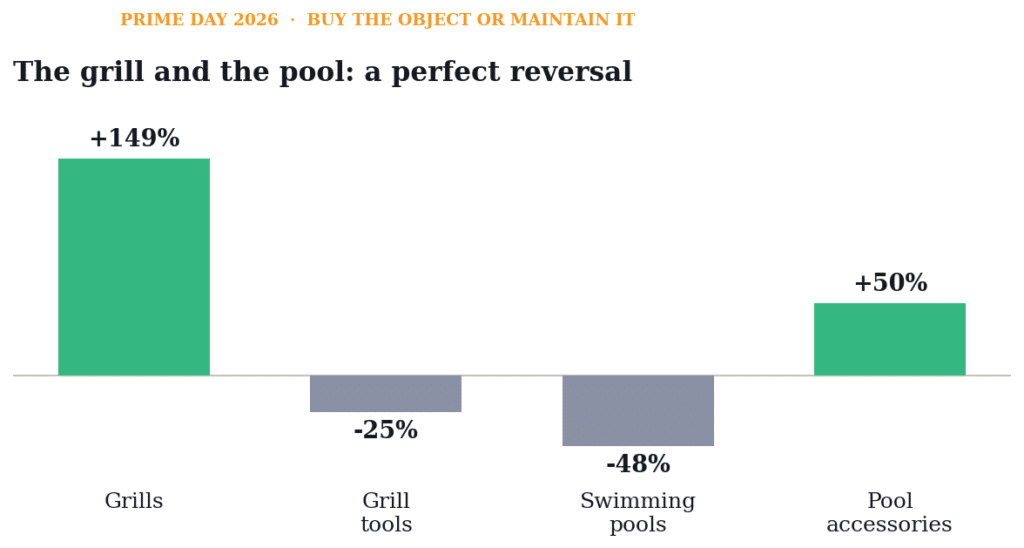
Two big-ticket outdoor purchases, two opposite behaviours. Shoppers bought new grills but skipped the tools to cook on them and maintained the pools they already owned rather than buying new ones.
The pattern holds right down to how people shop for their animals.
Dog beds and furniture rose 94%. Cat treats climbed 26%. But dog food fell 12%, and grooming supplies dropped 8%. Pet owners used Prime Day to buy their animals comfort and indulgence (the plush bed, the treats) while skipping the routine essentials they’ll simply reorder later at any price.
It’s the grill and the pool again, wearing fur. The fun purchase gets made in the moment. The necessary one waits.
The most revealing category might be health, because it shows people making these choices about themselves.
Some health purchases surged. Smoking cessation products rose 55%. Sleep supplements jumped 128%. Diabetes care climbed 38%. These are the health goals that feel urgent, aspirational, or tied to identity: the “I’m finally going to fix this” purchases that a sale gives people permission to commit to.
But the routine maintenance? Hair loss products fell 25%. Eye health supplements fell 28%. The unglamorous, ongoing, slightly depressing health items, the ones with no transformation narrative attached, got deferred.
People didn’t buy “health” during Prime Day. They bought the story of becoming a healthier person. The version of self-improvement that feels like a fresh start sells. The version that feels like admitting a problem does not.
Six unrelated categories: beauty, cameras, groceries, patio equipment, pets, health. And the same instinct running underneath all of them.
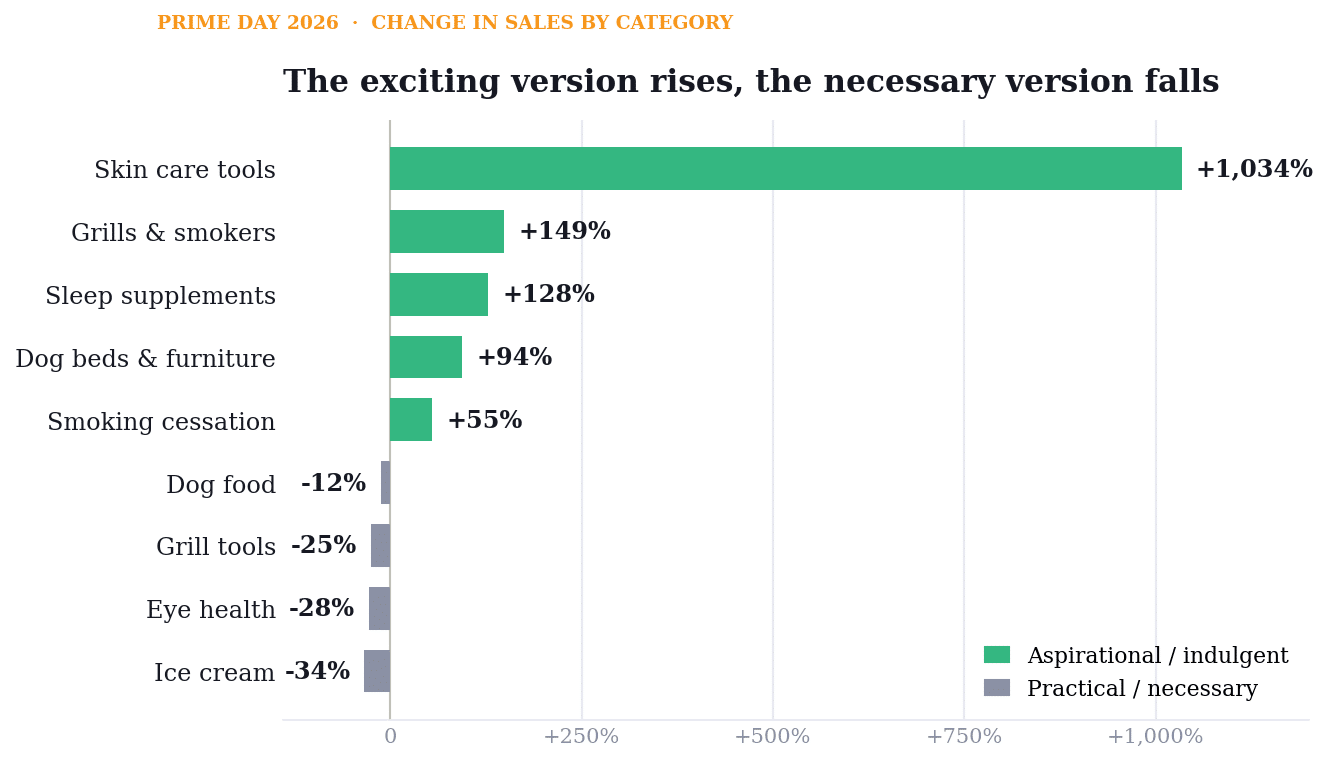
Across six unrelated categories, the same instinct: the exciting version of a purchase rose while its practical counterpart fell.
When everything is discounted at once, people don’t optimise. They don’t rationally stock up on necessities while prices are low. They do almost the opposite: they buy the exciting, aspirational, indulgent version of things and postpone the boring, necessary version of the very same things. The grill, not the tongs. The dog bed, not the dog food. The quit-smoking kit, not the eye vitamins. The gadget, not the groceries.
Prime Day is often described as the biggest test of consumer demand in the calendar. Maybe. But it’s a better test of consumer psychology. The discounts don’t just reveal what people want to buy. They reveal what people want to feel like. And for a few days each summer, at scale, in the data, we get to watch millions of people quietly choose the more hopeful version of themselves over the more practical one.
The fridge can wait. The future is on sale.

Set up in minutes with the help of our customer success team, or reach out to our sales team for any questions. Start your 15-day free trial—no credit card needed!
x


