AI Amazon Repricer
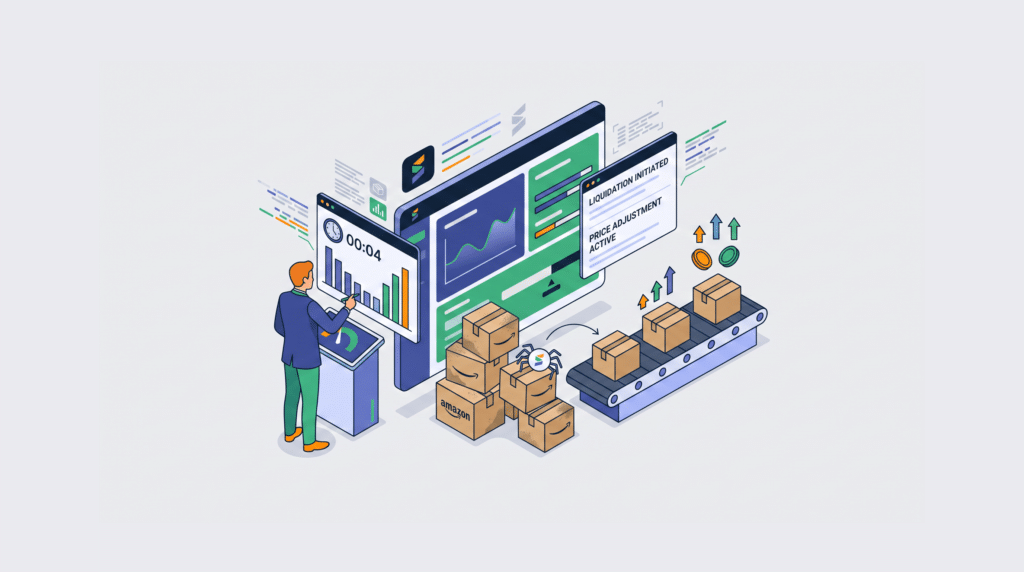
Boost your Amazon profits and avoid price wars with AI repricing


Amazon’s own retail division is not just another competitor in the Buy Box. It is a dynamic, algorithmically driven pricing machine with near-infinite capital, fulfillment dominance, and real-time data that no 3P seller can replicate through manual repricing alone. Sellers who fail to understand this reality surrender both margin and Buy Box share simultaneously. The path to 7-to-8-figure growth on Amazon demands a more sophisticated approach.
When Amazon holds the Buy Box, rule-based repricers react in a predictable, damaging way: they chase Amazon’s price down automatically until the listing becomes unprofitable or the repricer stalls at a floor and loses visibility. Amazon Retail pricing behavior changes constantly, driven by inventory stockouts, demand signals, and Buy Box rotation mechanics that create exploitable windows for 3P sellers. The best Amazon repricer for competing against Amazon identifies and captures those windows systematically. It is not a capability that rule-based tools were ever designed to deliver.
How AI Identifies Gaps in Amazon’s Stock and Pricing Rotation?
When Amazon holds the Buy Box on a shared ASIN, its effective exclusion of third-party offers is conditional rather than permanent. Amazon Retail pricing behavior follows predictable cycles: periodic price adjustments above competitive thresholds, inventory stockouts that temporarily interrupt Buy Box eligibility, and fulfillment lead time extensions during peak periods that reduce Amazon’s eligibility score. A per-ASIN AI repricing system analyzes historical pricing cycles alongside real-time demand signals to identify these rotation windows. It then determines the listing price at which a third-party offer can capture the Buy Box during each window while maintaining a configured profit margin protection floor. The mechanism operates on pattern recognition and predictive cycle modeling rather than reactive price-matching.
The Amazon 1P vs 3P dynamic has shifted dramatically, yet Amazon Retail remains a dominant force on high-value, high-margin ASINs where 1P control is strategically important to Amazon’s own revenue mix. According to Marketplace Pulse analysis of Amazon’s quarterly earnings data, third-party sellers reached 62% of paid units in Q4 2024, the highest quarterly share on record at that point. For sellers operating on ASINs where Amazon maintains 1P control, the absence of a deliberate pricing strategy is one of the fastest routes to eroding annual margin.
Amazon’s pricing engine does not operate on fixed rules. It responds to supply chain data, competitor pricing, demand forecasting, and conversion rate signals, updating prices thousands of times per day across millions of SKUs. When a 3P seller drops price to match Amazon Retail pricing behavior, Amazon often responds by dropping further, using pricing dynamics designed to maintain Buy Box rotation dominance on its own terms. This creates a race to the bottom that destroys margin for both sides, though Amazon absorbs it far more comfortably than any third-party seller can.
Buy Box suppression compounds the problem further. When Amazon holds the Buy Box and a 3P seller’s price falls within a competitive range, Amazon’s algorithm may still prevent the Buy Box from rotating unless specific fulfillment and performance thresholds are met. Sellers relying on manual pricing or legacy rule-based tools almost never have visibility into when those conditions change, and the competitive window opens and closes without them.
The best Amazon repricer for competing against Amazon does not attempt to match Amazon in real time through static rules. Seller Snap’s AI engine is built on AI repricing algorithms that analyze Amazon’s specific pricing rotation patterns for each ASIN. Rather than applying a global pricing rule, the system learns when Amazon typically rotates the Buy Box, when inventory stockouts create temporary 3P windows, and at what price point a 3P listing becomes eligible to win profitably.
No two ASINs behave identically in a 1P-competition context. Amazon Retail may rotate the Buy Box on one ASIN daily while holding another for weeks before a brief stockout opens a 24-hour window. Seller Snap’s AI repricing algorithms detect these patterns and position the seller’s price to capture the Buy Box during those rotations without unnecessarily compressing margin outside them. The result is a fundamentally different outcome from what rule-based tools produce on the same catalog.
Seller Snap’s Features page outlines the full capability set available to sellers managing competitive ASIN portfolios, but the core advantage in a 1P competition context is behavioral learning: an ongoing model of how Amazon prices each specific ASIN, updated continuously rather than governed by static rules. When Amazon leaves the Buy Box, even briefly, that model means the 3P position is already set to capture it. Visit sellersnap.io/features to see the full toolset.
Where rule-based tools stall when Amazon holds the Buy Box, Seller Snap keeps monitoring for rotation signals. The moment Amazon’s price rises, its fulfillment lead time extends, or an inventory stockout pulls it from eligibility, Seller Snap acts. That action is precise: the AI prices to win, not to race, ensuring profit margin protection is maintained throughout the cycle. This is the functional difference between a repricing tool and an intelligent repricing strategy.
Game Theory AI is not a marketing term at Seller Snap; it is the underlying architecture governing how the software behaves when multiple competitive pricing signals are present simultaneously. In a competitive Buy Box environment involving Amazon Retail, the risk of iterative price-matching creating a self-defeating downward spiral is real and quantifiable. Seller Snap’s Game Theory model evaluates whether chasing a lower price will produce a better return, or whether holding price and waiting for a Buy Box rotation is the superior strategic choice.
This prevents the most damaging failure mode in automated repricing. Without Game Theory logic, a repricer lowers price, Amazon lowers further, the repricer lowers again, and within hours, the ASIN is trading at or near cost with profit margin protection entirely gone. Seller Snap recognizes when competing directly benefits the seller and when it does not, adjusting behavior accordingly. For sellers managing hundreds of ASINs, that distinction compounds into a material annual margin differential.
Consider a concrete example. Amazon holds the Buy Box on a kitchen ASIN at $32.99; your 3P price sits at $30.49, losing margin without winning the Buy Box. A rule-based repricer stalls here. Seller Snap’s AI, by contrast, is evaluating four signals simultaneously: Amazon has held this price for 11 days (the ASIN’s historical stockout frequency is every 12–16 days); inbound replenishment data shows no new Amazon units arriving at tracked fulfilment centres; demand velocity has increased 22% in the past 48 hours, accelerating stock depletion; and a two-day fulfilment delay has appeared on Amazon’s offer. The AI’s decision: raise your price from $30.49 to $32.89 and hold — abandoning the floor — because waiting for the stockout window yields better expected returns than racing Amazon on price today. Within 14 hours, Amazon exits the Buy Box. Seller Snap captures it at $32.89 — $2.40 above where a rule-based repricer left margin on the table. When Amazon returns, the AI re-evaluates: if it re-enters below the configured floor threshold, hold and wait; if it re-enters at parity, shift to cooperative price-signal testing. The logic is not “how do I beat Amazon on price today?” It is “when does competing directly cost more than waiting, and when does the window open?” Applied across hundreds of ASINs with different stockout frequencies, price volatility profiles, and seasonal patterns, this distinction is where the annual profit margin protection differential is built.
Seller Snap’s Amazon AI Algorithmic Repricer page details how this Game Theory logic is implemented at the technical level, including how it integrates with Buy Box rotation data to refine per-ASIN decisions continuously over time. Sellers looking to understand the full architecture behind the competitive advantage can explore Seller Snap’s custom repricing strategies for additional context on strategy configuration.
Table 1: Rule-Based vs. AI Reaction to Amazon Retail Scenarios
| Scenario | Rule-Based Repricer | Seller Snap AI |
| Amazon raises its price above threshold | Slowly adjusts upward; often misses the window | Immediately captures Buy Box at full margin |
| Amazon holds the Buy Box at floor level | Drops to minimum floor price and stalls | Monitors for rotation; holds margin and waits |
| Amazon goes out of stock (inventory stockout) | May respond on next refresh cycle | Instantly positioned to capture the Buy Box |
| Amazon returns to the Buy Box | Drops price automatically to compete again | Evaluates profitability; avoids race to the bottom |
| Multi-week consistent 1P hold | No adaptive learning; applies same rules | Builds ASIN-specific behavioral pricing model |
Strategic Gaps to Exploit When Competing Against Amazon Retail
Sellers operating with a systematic approach should monitor the following competitive windows that consistently create Buy Box opportunities against Amazon Retail.
The structural shift in the marketplace underscores why a systematic approach to competing against Amazon Retail matters for serious sellers. According to Amazon’s Q4 2024 earnings call, third-party sellers made up 61% of all items sold across full-year 2024 — the highest annual Amazon 1P vs 3P unit mix in the company’s history. Amazon’s Q4 2024 earnings release, filed with the SEC, shows third-party seller services — the commissions and fees collected from independent sellers — generated $156.1 billion in 2024, representing nearly one in four dollars of total company revenue. Amazon is transitioning from a retailer to a platform operator, which means its 1P presence is becoming increasingly concentrated on the specific high-margin ASINs it considers strategically important.
For 7-to-8-figure 3P sellers, the competitive landscape is not defined by Amazon’s overall growth. It is defined by Amazon’s selective, high-value 1P presence on ASINs where profit margin protection is worth actively defending. Sellers who build a systematic Buy Box rotation intelligence advantage on those listings compound it across their entire catalog over time.
No rule-based repricer was designed to compete with Amazon’s pricing intelligence at a per-ASIN behavioral level. The best Amazon repricer for competing against Amazon must operate at a fundamentally different level: learning per-ASIN patterns, applying Game Theory to avoid margin destruction, and capturing the Buy Box the moment Amazon’s grip loosens. That capability does not exist in rule-based logic. It exists in AI repricing algorithms built on live competitive data at the per-ASIN level.
Seller Snap is the only repricing platform built on this architecture. Sellers operating at seven- and eight-figure levels can start a 15-day free trial and immediately begin building the per-ASIN behavioral intelligence that separates a profitable Buy Box rotation strategy from expensive guesswork. The Amazon 1P vs 3P competitive window is real. The question is whether the repricing tool in use can exploit it.
 4.9 on the Amazon App Store