AI Amazon Repricer
Boost your Amazon profits and avoid price wars with AI repricing


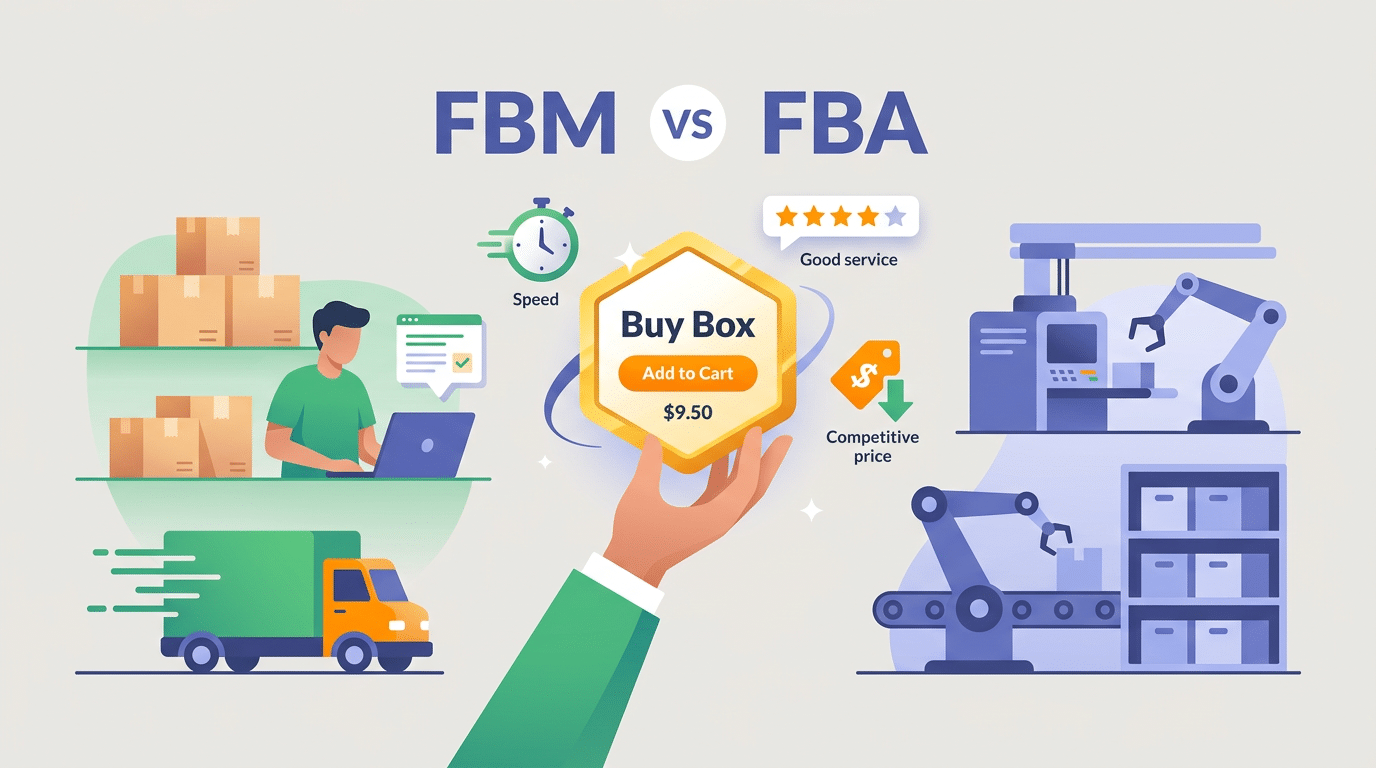
Millions of sellers walk away from FBM every year because they believe the Prime badge is an insurmountable Buy Box advantage. That belief costs them inventory flexibility, margin control, and the ability to scale logistics operations outside Amazon’s fulfillment network. The reality is more nuanced: Amazon’s Buy Box algorithm does not directly reward the Prime badge. It rewards the total value proposition delivered to the customer, and FBM sellers who understand that distinction can compete at the highest level.
A sophisticated Amazon repricer FBM vs FBA approach does not blindly undercut FBA prices to win the Buy Box. It calculates the exact margin of competitive advantage needed to offset the Prime delivery perception, protects FBM profit margins, and adjusts dynamically as Amazon fulfillment fees and FBA competitor prices shift. Rule-based tools were never designed to make that calculation at the per-ASIN level. An AI repricing engine that understands fulfillment context is the only viable solution for million-dollar FBM operations.
How Seller Snap Calculates the FBM Buy Box Price Gap?
When an FBM listing competes against an FBA offer for the Buy Box, Amazon’s algorithm evaluates total landed cost: the FBM listing price plus the buyer-visible Merchant Fulfilled shipping costs compared against the FBA offer price. An AI repricer calculates this landed cost differential at each repricing cycle to determine the minimum price adjustment required to reach Buy Box parity without reducing below the margin floor. Seller Snap applies this calculation dynamically, using live Buy Box data and per-ASIN cost inputs to identify the minimum price adjustment for parity while maintaining configured FBM profit margins as a floor constraint.
Amazon’s Buy Box algorithm evaluates offers against a weighted set of fulfillment and performance factors, not directly against Prime membership status. Buy Box parity for FBM sellers is achievable because the algorithm accounts for the shipping lead time differential through a price weighting mechanism, not through a categorical exclusion. FBM sellers who maintain strong account health, competitive pricing on total landed cost, and reliable shipping lead time performance have won Buy Boxes across high-volume ASINs consistently, even against FBA competition at similar price points.
The Buy Box calculation Amazon applies for FBM vs FBA offers factors in the shipping cost the customer pays. When a customer views an FBA listing at $29.99 with free Prime shipping and an FBM listing at $25.49 with $4.99 shipping, the total landed cost is $29.99, not $30.48. That gap of $0.49 is not insurmountable. Amazon’s algorithm weights these offers against each other on a landed cost basis, which means an FBM seller does not need to undercut the FBA price by the full shipping amount to achieve Buy Box parity. The gap required is smaller and more calculable than most sellers assume.
The Seller Fulfilled Prime program narrows this gap further for qualifying sellers. Seller Fulfilled Prime allows FBM sellers to display the Prime badge by committing to two-day delivery from their own warehouses, substantially reducing the Buy Box discount required to compete against standard FBA listings. However, SFP qualification standards are demanding, and most FBM sellers compete without the badge. For that majority, the repricing strategy must be precise, not aggressive.
A purpose-built Amazon repricer FBM vs FBA strategy requires the tool to understand fulfillment context, not just listing price. Most legacy repricers treat FBM and FBA listings identically, applying the same floor-and-ceiling logic regardless of whether the seller is absorbing Merchant Fulfilled shipping costs or warehousing inventory through Amazon. Seller Snap’s AI was built to distinguish between these fulfillment contexts and calculate the appropriate competitive position for each.
When Seller Snap reprices an FBM listing competing against FBA offers, the AI calculates the live price differential needed to achieve Buy Box parity based on the current FBA Buy Box price and the estimated shipping cost visible to the buyer at the time of repricing. This is not a static rule. It updates in real time as the FBA Buy Box price moves, as competitor offers enter or exit the listing, and as Merchant Fulfilled shipping costs shift by region or carrier rate. The result is an FBM offer that is always positioned at the precise competitive threshold, not below it.
The critical distinction is that Seller Snap does not simply drop the FBM price to win. It calculates where the offer needs to be and holds it there, protecting FBM profit margins rather than eroding them through over-discounting. For sellers managing significant FBM catalog depth, the difference between winning at the right price and winning at any price compounds into a substantial annual margin impact. Sellers can configure minimum margin thresholds within Seller Snap’s custom repricing strategies, ensuring profitability floors are never breached regardless of how aggressively FBA competitors move.
Seller Snap’s full capability set, outlined on the Features page, also accounts for the seller performance metrics that affect Buy Box eligibility for FBM offers. A repricing strategy that wins the Buy Box only to have the listing suppressed due to shipping lead-time violations or cancellation-rate issues yields no value. Seller Snap monitors the full competitive context, not just the price axis, so FBM strategies operate within sustainable performance parameters from the outset.
The foundational calculation for any FBM repricing strategy is total landed cost: the sum of product cost, Amazon fulfillment fees (avoided with FBM), Merchant Fulfilled shipping costs, packaging, and return handling overhead. This is the true cost of an FBM sale, and it must be accurately reflected in the floor price configured in any repricer. Sellers who set floor prices based solely on unit cost, without accounting for Merchant Fulfilled shipping costs, consistently underprice FBM offers and destroy margin at scale without realizing where the leakage originates.
Amazon’s 2025 FBA fee structure includes fulfillment fees, storage charges, inbound placement fees, and seasonal surcharges, which together can consume 15% to 25% of revenue, depending on category and unit size. FBM sellers avoid these Amazon fulfillment fees but incur direct Merchant Fulfilled shipping costs, packaging, and labor. For oversized, heavy, or high-value items where FBA fees are disproportionately large relative to the item value, the FBM landed cost advantage is substantial, and the Buy Box discount needed to compete with FBA is minimal. Understanding the full FBA fee structure per category is essential before configuring FBM floor prices. Sellers can reference Seller Snap’s FBA fulfillment fee breakdown as a starting reference point.
Seller Snap’s Amazon Seller Analytics tools provide the per-ASIN cost visibility needed to set accurate FBM floor prices and track FBM profit margins over time. Without that data layer, repricing operates blindly against cost structures that shift with every Amazon fulfillment fees update, carrier rate revision, or category fee change. The analytics and repricing layers must work together for FBM to be systematically profitable at scale.
Table 1: Buy Box Weighting Factors: FBA vs. FBM
| Weighting Factor | FBA Seller | FBM Seller | Seller Snap Repricing Impact |
| Shipping Lead Time | 1–2 days (Prime standard) | 3–7 days (standard FBM) | AI offsets lead time disadvantage via precise landed cost pricing |
| Total Landed Price | Listing price (free shipping) | Listing price + buyer shipping cost | AI calculates exact parity gap dynamically per repricing cycle |
| Prime Badge | Automatic with FBA | Requires Seller Fulfilled Prime | SFP-qualified FBM reduces required Buy Box discount significantly |
| Seller Metrics (VTR) | Amazon-managed | Seller-managed (strict 95% VTR) | Not a price lever, but gates Buy Box eligibility for FBM offers |
| Amazon Fulfilment Fees | 15–25% of revenue (2025 structure) | Avoided, replaced by direct shipping | Avoided FBA fees inform FBM floor price and margin floor config |
| Buy Box Pricing Basis | Listing price benchmarks competitor | Must achieve landed cost parity | Seller Snap positions at exact parity threshold, not below it |
Strategic FBM Buy Box Levers for Million-Dollar Sellers
The following factors determine whether an FBM repricing strategy delivers profitable Buy Box wins at scale or erodes margin without producing sustainable results.
The scale of FBM usage on Amazon is frequently underestimated by sellers who treat FBA as the default and FBM as a fallback. According to Jungle Scout’s State of the Amazon Seller 2025 report, more than a third of Amazon sellers use FBM either exclusively or as part of a hybrid fulfillment model, with separate industry data suggesting approximately 22% run explicit hybrid strategies that switch between FBM and FBA based on product margin, unit size, or seasonal demand patterns. Amazon’s marketplace hosts approximately 1.9 million active sellers globally — those maintaining live listings and actively fulfilling orders, out of around 9.7 million total registered accounts — and that active seller base represents a substantial population of operators whose Buy Box parity depends directly on the quality of their Amazon repricer FBM vs FBA strategy.
The financial rationale supports the strategic shift. Industry estimates suggest FBM sellers using consolidated shipping arrangements can achieve per-unit cost savings of approximately 30% against standard major carrier rates, and hybrid models combining FBA for high-velocity ASINs with FBM for tail inventory are broadly cited as reducing total fulfillment cost across the catalog by 15% to 40%, depending on category mix and carrier arrangements. The margin opportunity in FBM is real and significant. The FBM profit margins available on the right categories, managed with the right repricing intelligence, represent one of the most underleveraged opportunities available to established Amazon sellers in 2025.
Managing FBM Buy Box parity manually across hundreds or thousands of ASINs is not a scalable strategy for million-dollar sellers. The landed cost calculations are too dynamic, the competitor price movements are too frequent, and the margin risk of miscalculation is too significant. Seller Snap’s Amazon repricer FBM vs FBA capability automates the entire calculation cycle, positioning FBM offers at the precise competitive threshold in real time without requiring manual intervention per ASIN or per competitor price movement.
Sellers ready to build a systematic FBM repricing operation can start a 15-day free trial and immediately apply Seller Snap’s AI to their existing FBM and hybrid catalogs. The Buy Box does not require a Prime badge to win. It requires the right price, calculated against the right cost structure, adjusted at the right moment. Seller Snap delivers all three simultaneously across every ASIN in the catalog, without compromising FBM profit margins.
 4.9 on the Amazon App Store