AI Amazon Repricer
Boost your Amazon profits and avoid price wars with AI repricing
 Skip to content


Two months ago we launched Local Buy Box repricing. Here is what changed on Amazon, and what it means for how you price
Share this post


Seller Snap launched Local Buy Box repricing two months ago, starting with our existing customers and the seller communities we work with. Here is what changed on Amazon, and what you need to know about pricing for it.
On 15 September, Prime members in Dallas, Denver and Delaware were all shown the same DEWALT battery at $68.96. At the same moment, Prime members in Alaska were shown a different seller’s offer, at $100.00. Same listing, same second, two different winners, and the only thing that changed was where the shopper was.
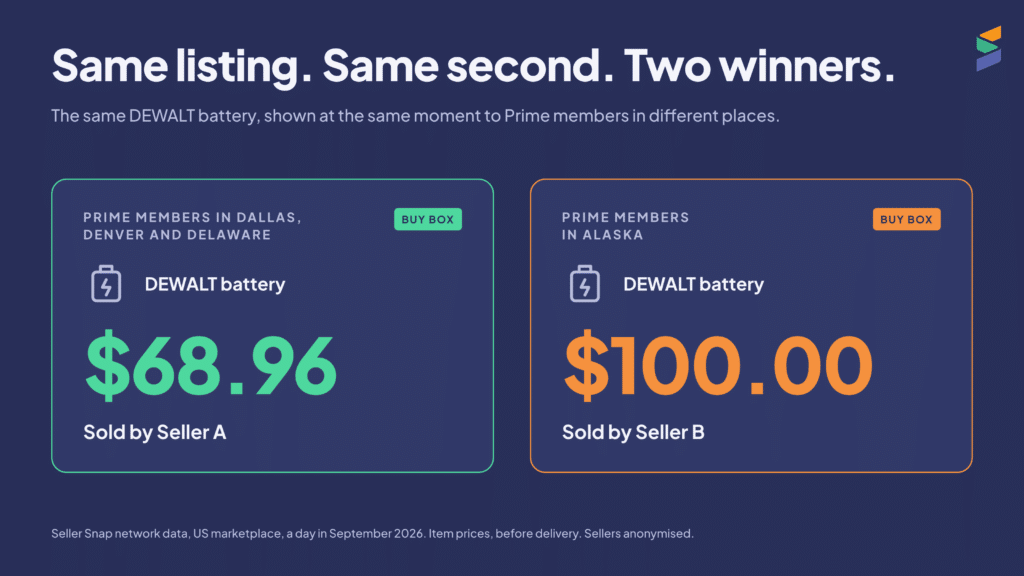
That is not a glitch, and it is not a one-off. Between 1 and 22 September, 820 readings of that listing covered both areas, and the two saw different winners in every single one. Amazon no longer awards one Buy Box per listing. It awards them by area, and shoppers in different places can see different sellers featured on the same product at the same time.
If you have ever looked at a Buy Box share figure that barely moved while your sales fell, or cut your price and watched nothing happen, this is part of the reason. The number you are reading is an average of thousands of separate contests, and an average is very good at hiding which ones you are losing.
We looked at 462,589 US listings across September, read 362.6 million times between them. On 12% of those listings, shoppers in different areas saw different sellers winning at the same moment at some point during the month. Counting Prime status alongside area, it was 35%, and on listings with five or more sellers, 71%.
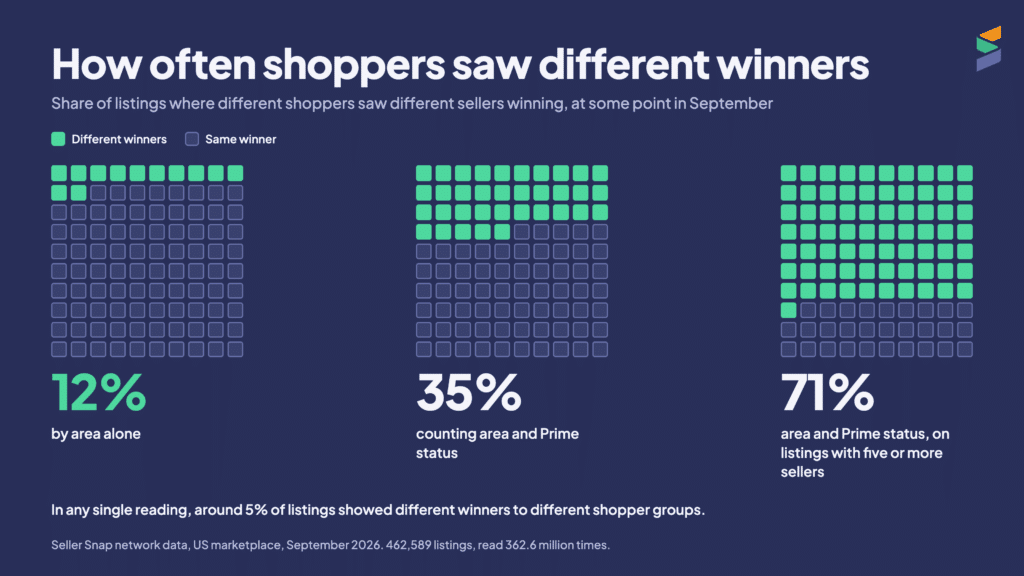
In any single reading, around 5% of listings showed different winners to different shopper groups. That number is worth holding onto. This is not happening on every listing all of the time. It is happening often enough, and invisibly enough, that a national average cannot show it to you.
In September, shoppers in Alaska were shown a different seller from the one most shoppers saw in 25% of readings. In the Miami area it was 3%.
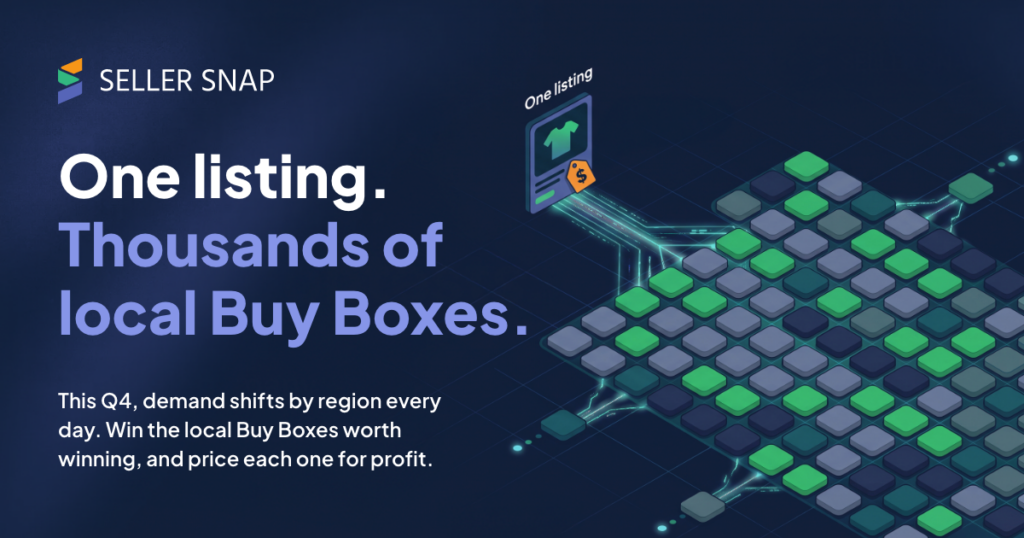
If there are thousands of local contests rather than one national one, a single price is one answer to thousands of separate questions. It will win some and lose others. The problem is not that it compromises. The problem is that you cannot see which way.
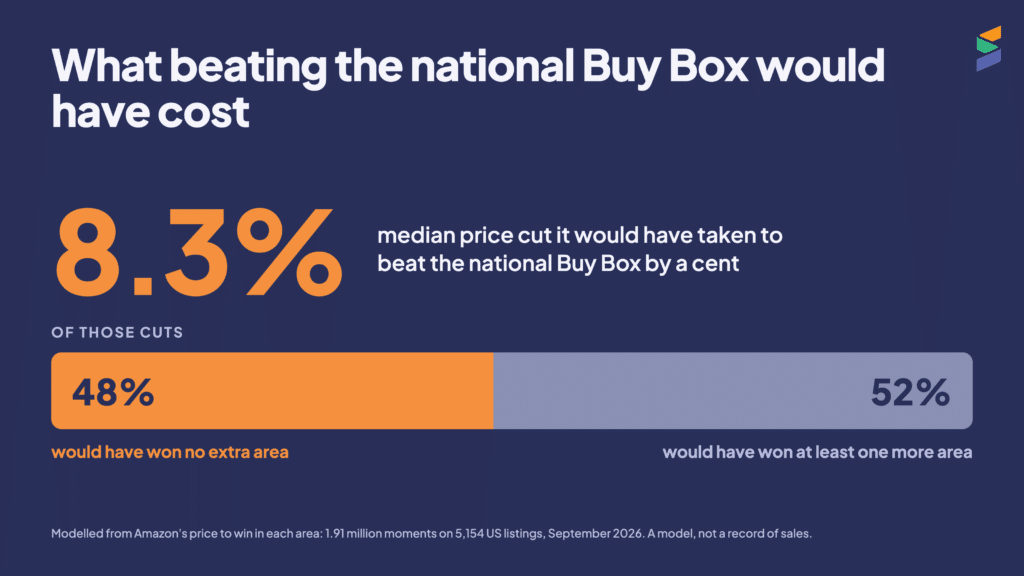
In the same data, beating the national Buy Box by a cent would have meant a median price cut of 8.3%, and 48% of the time that cut would have won no extra area at all. Roughly half the time, the margin would have bought nothing.
That is modelled from Amazon’s own price to win in each area, across 1.91 million moments on 5,154 US listings where a rival held the national Buy Box at a lower price. It is a model of what a cut would have achieved, not a record of sales.
It runs the other way too. Where shopper groups saw different winners, the other group’s winner was the more expensive offer 44% of the time and the cheaper offer 31% of the time, with the two within half a percent the rest of the time. Cheaper does not reliably win, which means the reflex of dropping price to recover share is often answering a question that was never asked.
A repricer that sets one national price is answering a question Amazon has stopped asking.
Adrian Rich, CEO
Put those together and a single national price is losing you sales in places you cannot see, while giving away margin in places where you were already winning. The national percentage averages the two and reports a number that looks stable.
There is no Buy Box share. There are thousands of them, and each one moves on its own.
That 8.3% figure is the uncomfortable one, and it leads somewhere the industry has avoided for a decade.
Share is bought with margin. If half of the cuts you make to beat the national Buy Box win you no extra area, then half that margin bought nothing at all. Some contests cost more margin than the order returns. A system that treats every Buy Box as equally worth winning will buy you share you never wanted at a price you would not have agreed to.
The question is not how many Buy Boxes you are winning. It is whether the ones you are winning are the ones worth having.
A listing still carries one price. That has not changed and it cannot.
What changes is how that price is chosen. Rather than pricing to a single national contest, Seller Snap reads how the Buy Box is being awarded across areas and chooses one price with all of those contests in view, accepting that it will win in some places and lose in others, as a decision rather than an accident.
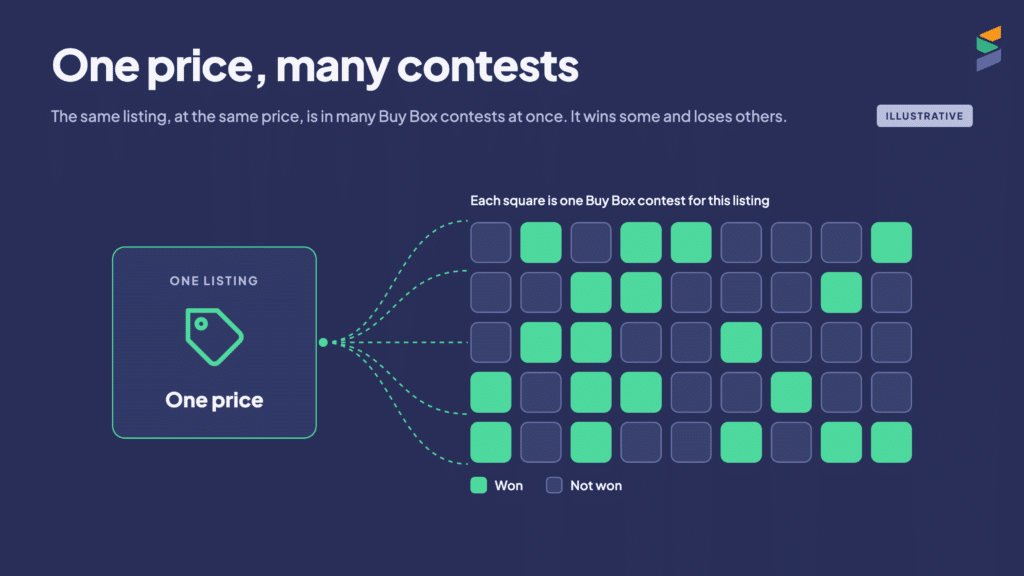
Reading one listing in one area is one problem. Pricing thousands of local contests together, weighed against what your business is actually trying to do, is a different one. That second problem is the one we built for.
It works inside the minimums and maximums you set, and respects MAP and Amazon’s Competitive Price Threshold.
Local Buy Box repricing was not a feature we planned on a roadmap. It came out of how we work.
Seller Snap is a data science company. Every price change we make is a measurement, and our pricing experimentation framework tests changes against each other on live listings. When the results stopped fitting a single Buy Box model, we went looking for the reason, and found that the Buy Box had gone local.
Repricing is also a game. Your price only matters relative to what the other sellers on a listing do next, which is why we build on Game Theory rather than fixed rules. A game played in thousands of local markets at once needs an answer in each of them.
That is the philosophy. Test, measure, publish what we find, and build for the market as it is rather than as it used to be. Local Buy Box is the clearest example so far. It will not be the last.
Seller Snap network data, US marketplace, September 2026. The sample is 462,589 US listings that our customers had offers on, read 362.6 million times, keeping listings read at least 30 times in the month. Figures cover consumer buyers only, which is what Amazon’s area data reports, so business buyers are not measured. Delivery speed and inventory location are inferred rather than measured. Prices are item prices before delivery. One month of observation, so these are findings from September rather than a claim about every month. Sellers are anonymised
Local Buy Box repricing applies to Amazon, not Walmart. Local Buy Box data is not currently available in the Netherlands, Belgium, Poland, Sweden, Ireland, Turkey, Saudi Arabia or the United Arab Emirates.


 4.9 on the Amazon App Store
x


