AI Amazon Repricer
Boost your Amazon profits and avoid price wars with AI repricing
 Skip to content


If you run an eCommerce business long enough, the questions you ask start to change.
Share this post


If you run an eCommerce business long enough, the questions you ask start to change.
Early on, it’s easy to fixate on daily fluctuations: Why did orders spike today? Why did yesterday drop?
Over time, more useful questions emerge:
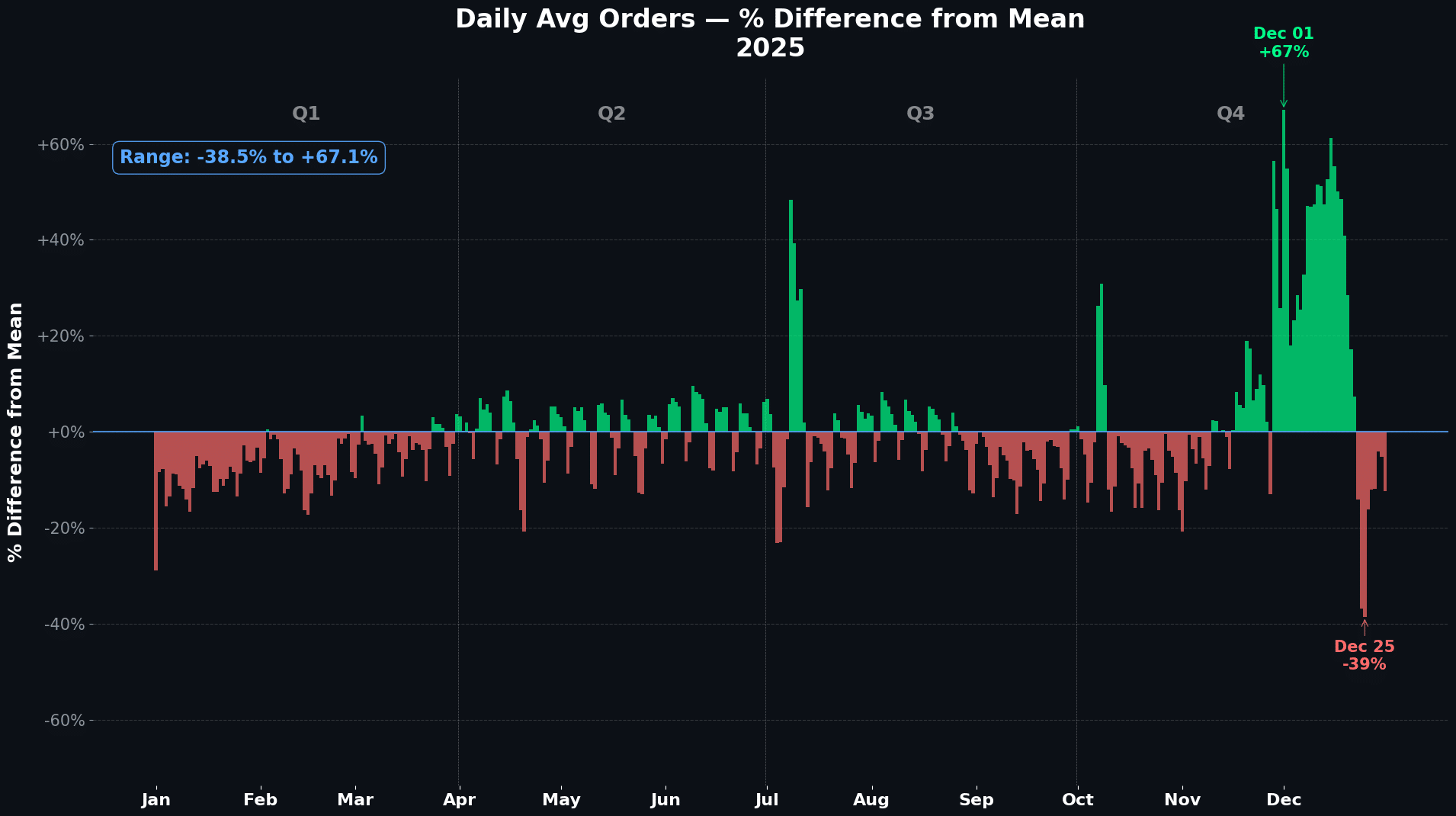
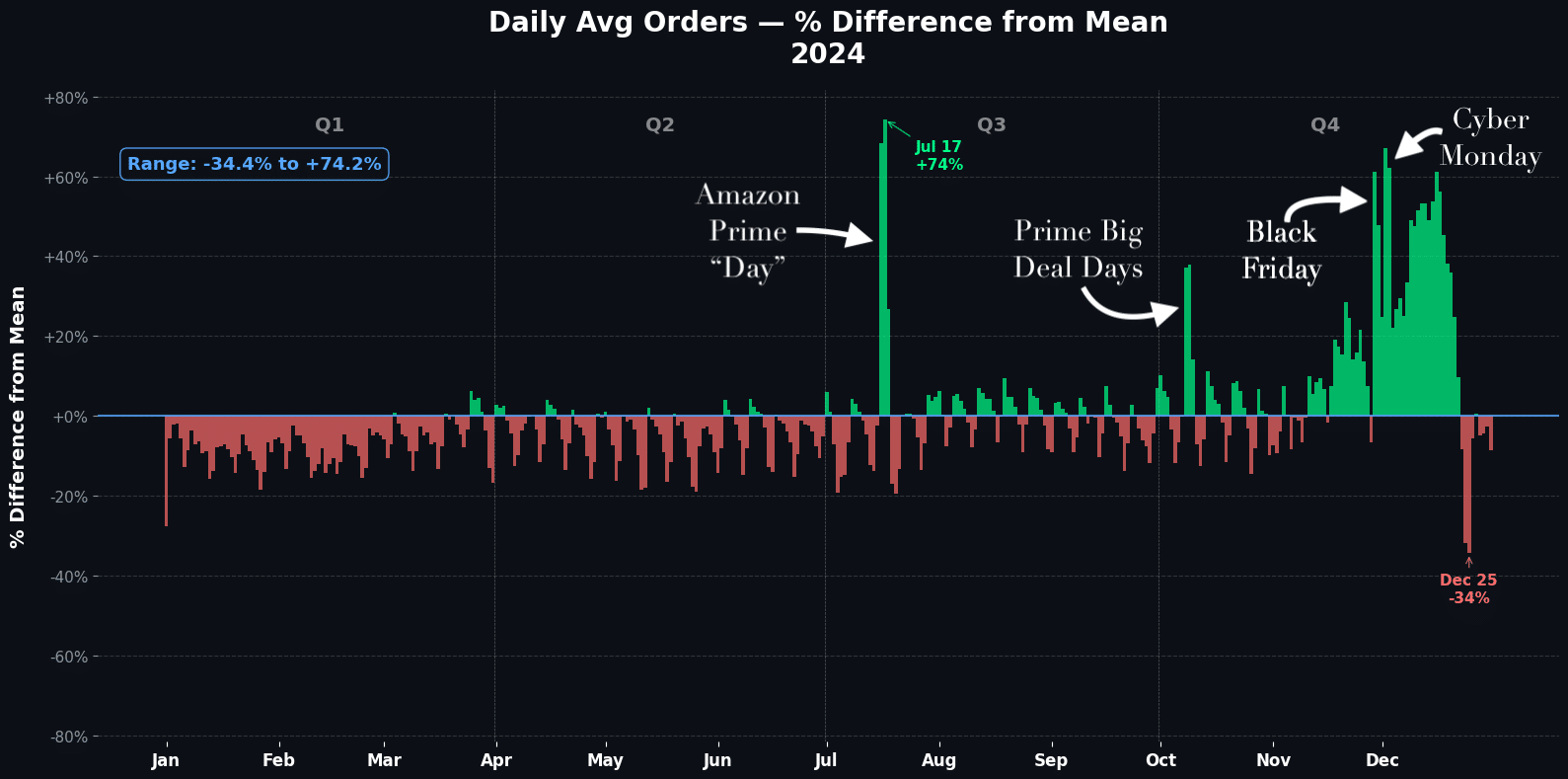
To answer those questions, Seller Snap analyzed daily order volume across 2024 and 2025, indexing each day as a percentage difference from that year’s average daily orders.
This approach matters. By normalizing each year against its own baseline, we remove the noise of “bigger year vs. smaller year” and focus on what actually drives outcomes at scale:
📌 how extreme each day is relative to normal performance.
When we examine both years through this lens, several structural patterns emerge. Four moments in particular consistently shape performance, planning, and operational outcomes.
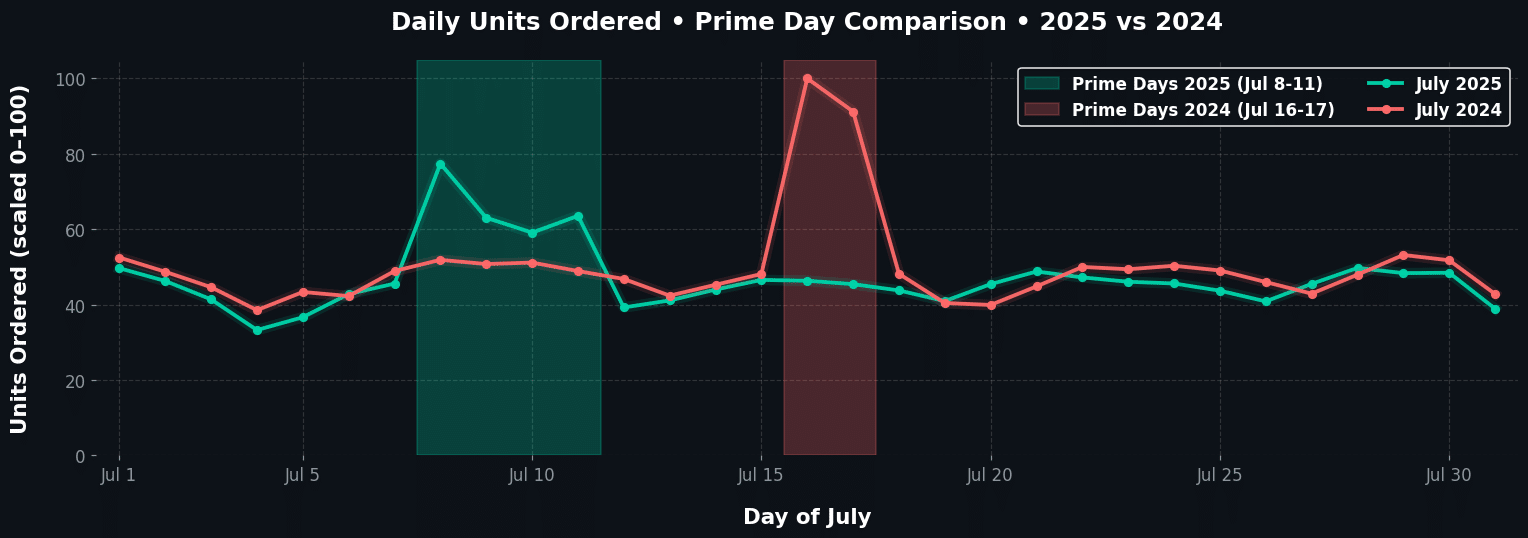
Seller Snap data shows that July has become one of the most structurally important periods in the eCommerce calendar – not because of a single promotional day, but because of how demand now concentrates around Prime events.
In 2024, the largest single-day spike of the entire year occurred in mid-July, reaching roughly +74% above that year’s average daily order volume. That magnitude is not incidental. It reflects a demand event large enough to stress pricing systems, inventory availability, advertising efficiency, and fulfillment operations simultaneously.
At this scale, Prime Day is no longer just a traffic opportunity. It has become a convergence point for multiple systems: conversion, pricing, inventory, and operations. When any one of those systems falls out of alignment, the impact shows up immediately in the data.
In 2025, July again delivered a meaningful uplift, but the shape of demand changed. Instead of a single towering peak, there were four days of increased lift because Amazon actually made the event span 4 days from July 8–11, 2025. And shoppers listened. This suggests that not only is it very important to keep track of Amazon’s deal calendar but that July is increasingly functioning as an early signal of holiday demand rather than a standalone event.
The implication is clear: July is no longer just about winning Prime Day.
It has become a rehearsal. How pricing, inventory, and operational systems perform in July often previews how well they will hold up when Q4 demand arrives.
How we think about this at Seller Snap:
Because these demand shifts are predictable, pricing strategies need to adapt dynamically to event-driven volatility rather than reacting after the fact. When pricing systems respond in real time, teams can focus less on firefighting and more on execution.
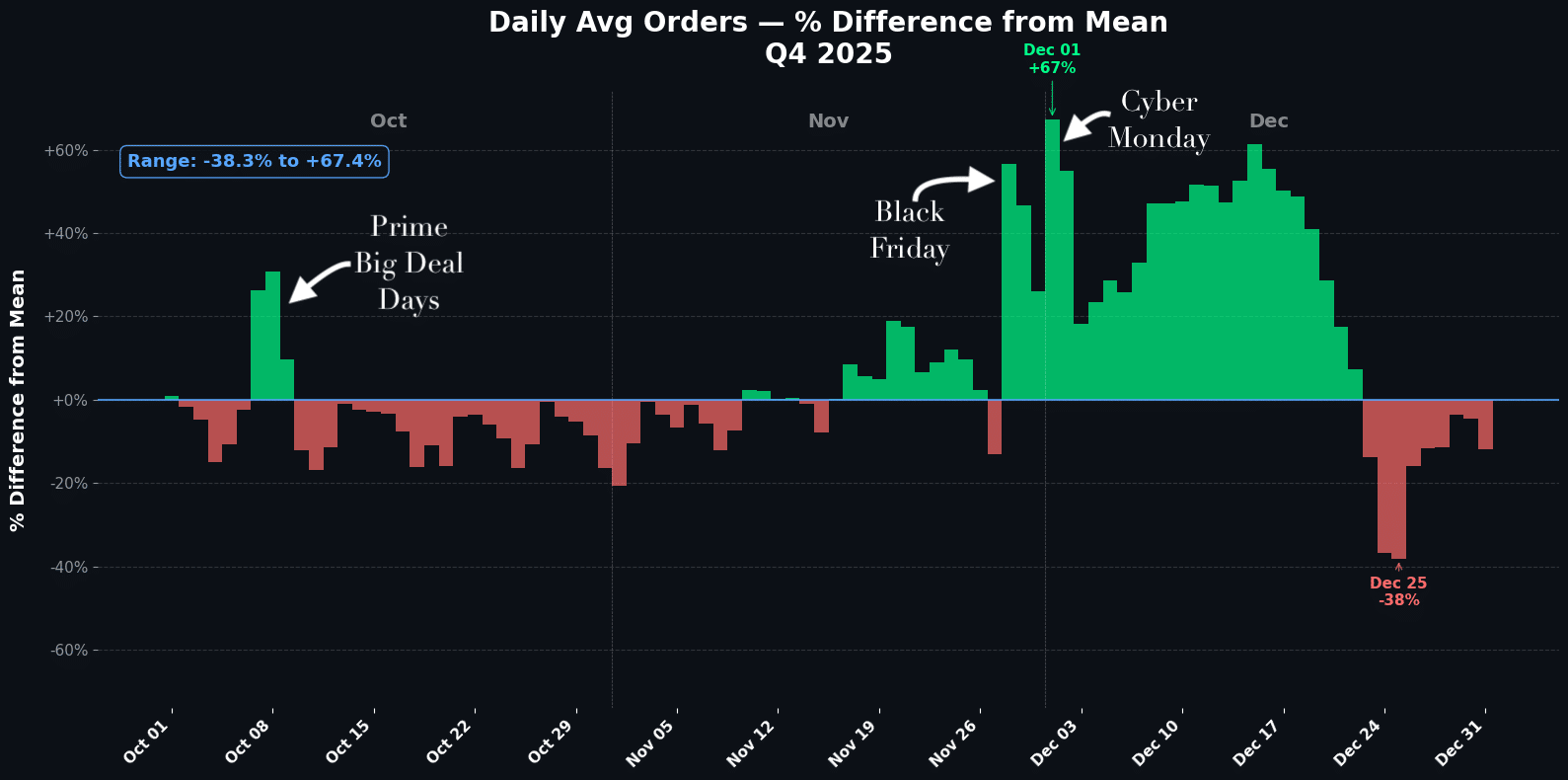
Seller Snap data also highlights October as a critical inflection point in both years, driven largely by Amazon’s Prime Big Deal Days and surrounding promotional activity.
Even when the rest of the year exhibits uneven demand, October consistently introduces short-term acceleration that creates ripple effects downstream. These bursts place pressure on supply chains, introduce pricing volatility, and force rapid competitive repositioning.
Importantly, this demand is not “free.” It pulls consumer intent forward and reshapes purchasing behavior later in the quarter. How teams handle October directly affects November and December performance.
Seller Snap data suggests a more accurate framing: October is the start of the holiday runway.
Teams that treat it as a one-off promo week often find themselves reacting in Q4 instead of executing against a plan.
Black Friday and Cyber Monday are often discussed as isolated peaks, but Seller Snap data tells a more operationally meaningful story.
Across both 2024 and 2025, the strongest performance did not come from a single day. Instead, it came from clusters of sustained, above-average days surrounding the event window.
Sustained demand changes the nature of execution. Reorder points become more critical. Advertising budgets require pacing rather than aggressive front-loading. Pricing decisions must remain responsive day-to-day. Fulfillment capacity becomes a constraint faster than many teams anticipate.
In practice, success during Black Friday and Cyber Monday is rarely about one moment.
It’s about maintaining alignment before the event, during the surge, and in the days immediately following.
The data reinforces a consistent pattern: the winners don’t “win” Black Friday itself. They win the extended window around it.
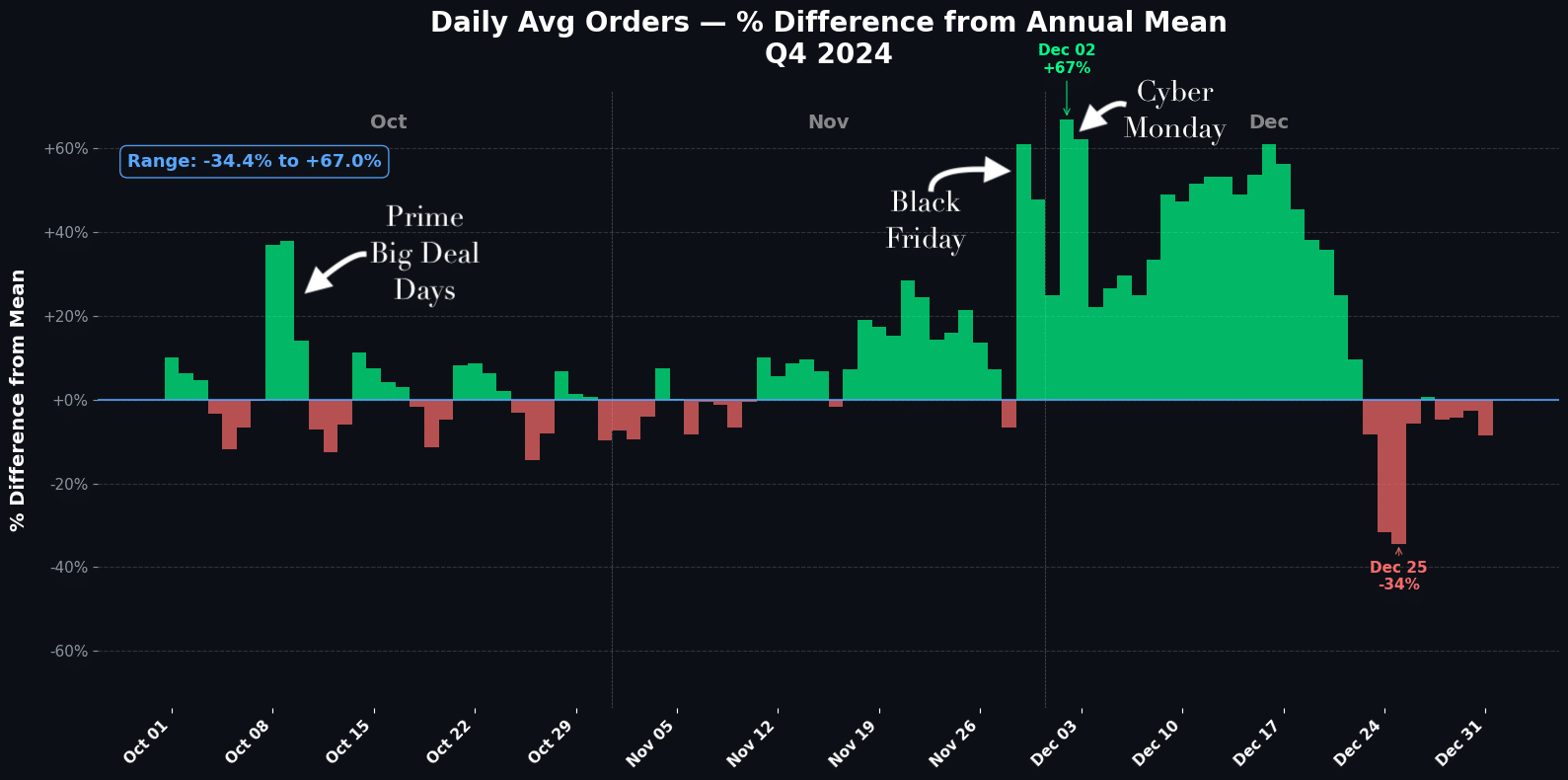
Among the most consistent patterns across both years is the sharp decline observed on Christmas Day.
Seller Snap data shows a drop of approximately -34% versus the annual mean in 2024, and an even steeper -38% drop in 2025. These declines are predictable, yet they remain emotionally and operationally loud when they occur.
The reason is simple: high-volume periods are often misinterpreted as continuous. Consumer attention, however, is not linear, even during the holidays. December does not mean “always up.”
For businesses built around holiday momentum, this dip can create unnecessary stress if it’s treated as a performance failure rather than a seasonal constant.
Christmas Day isn’t a failure. It’s a seasonal law.
The data makes it clear that it’s something to plan around, not react to.
Zooming out, several structural truths emerge from Seller Snap data:
Volatility is the cost of growth. Increased opportunity brings increased operational strain.
What this means in practice:
Planning around these patterns requires pricing, inventory, and forecasting systems that can absorb volatility without constant manual intervention. At Seller Snap, this structural view of demand is what informs how we evaluate and design pricing strategies at scale.
Based on two years of data, a clear operating playbook emerges:
Plan for peaks earlier than feels comfortable.
Preparing for Black Friday in November is too late. The data consistently suggests that September—or earlier—is when preparation truly begins.
Treat pricing and inventory as a single system.
Strong pricing without inventory leads to wasted demand. Inventory without pricing strategy leads to margin leakage.
Optimize for consistency, not just spikes.
Spikes are exciting. Repeatable performance is what compounds over time.
Seller Snap data reinforces a simple conclusion: the most effective operators don’t eliminate volatility. They design systems that perform predictably within it.
If you’re rethinking how pricing fits into your 2026 planning, Seller Snap works with sellers who want pricing systems that account for seasonality, demand spikes, and competitive volatility automatically, so teams can plan earlier and react less.
If this analysis resonates, it may be worth exploring how a data-driven repricing approach fits into your broader growth strategy.





Set up in minutes with the help of our customer success team, or reach out to our sales team for any questions. Start your 15-day free trial—no credit card needed!
x


